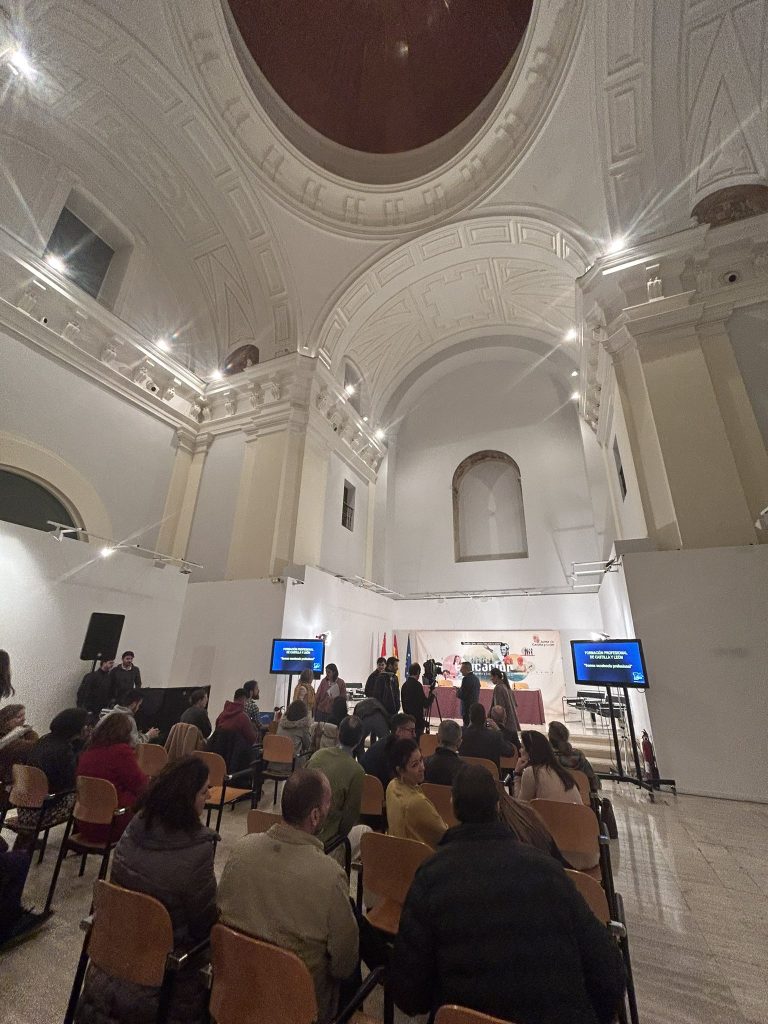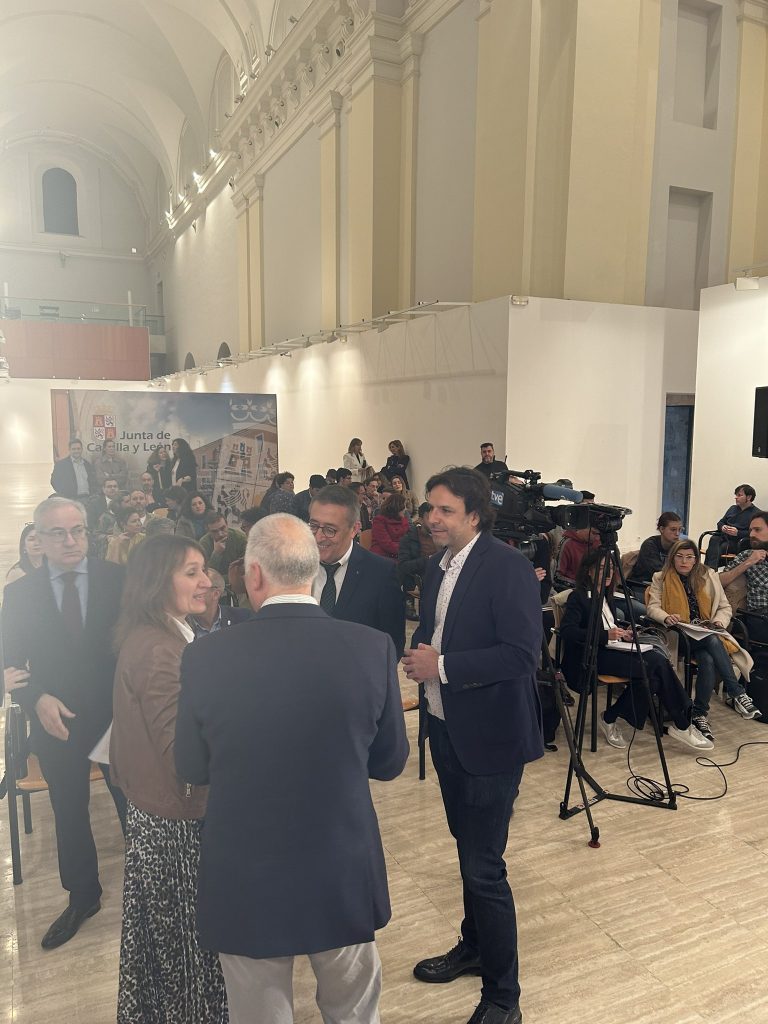


Last Wednesday, INFODEF participated in the presentation of the international HABITABLE project at the headquarters of the Department of Education of the Regional Government of Castilla y León. This ambitious project, approved in the latest Erasmus+ call, has asits main goal to address the shortage of workers skilled in digitalization and green transition competencies in the habitat sector at the European level. It is a CoVE (Centers of Vocational Excellence) project, an initiative that brings together vocational training centers from various countries to develop innovative actions and resources, promoting excellence in education and vocational training through international and multi-sector collaboration.
Jesús Boyano, as director of INFODEF, spoke at the presentation of the project that they will work on for the next 48 months. The event also featured the participation of prominent representatives from the education and habitat sectors, including Rocío Lucas, Minister of Education of the Regional Government; Agustín Sigüenza, Director-General of Vocational and Special Training; Enrique Cobreros, Director of the Efficient Habitat Cluster (AEICE); Pablo Sabín, Executive Director of Cesefor; Eva Testa, President of the Institute of Construction of Castilla y León; and Pedro Fernández, President of the Construction Labour Foundation.
About the HABITABLE project
The HABITABLE project, with a budget of 4 million euros, seeks to enhance the responsiveness of vocational education and training (VET) within a “skills ecosystem” for the habitat sector. To achieve this, it proposes active collaboration between VET institutions, local partners, and an international network of Centers of Vocational Excellence (CoVE). The main goal of this skills ecosystem is to contribute to regional development, innovation, smart specialization, and public-private collaboration strategies in the habitat sector by providing skilled personnel to the specific value chains of industrial ecosystems linked to the sector.
The project will begin with an intelligent analysis of demand and a study of the training provided by existing VET entities. This will be accomplished through the development of necessary digital tools that will enable the creation of a continuous training strategy for trainers, workers, and employers in the habitat sector. A certification system with micro-credentials will keep workers’ curricula up to date and propose training pathways to enhance their skills intelligently. Additionally, a dissemination strategy will be deployed to extend the project’s tools and methodology to all European regions.
The HABITABLE project is coordinated by AEICE and brings together the efforts of 17 partners from six European countries (Spain, Portugal, Austria, Greece, Georgia, and Moldova). The project consortium includes AEICE, the Department of Education of the Regional Government of Castilla y León (Spain), the Institute for the Promotion of Development and Training (INFODEF), the Foundation Institute of Construction of Castilla y León ICCL (Spain), the Foundation Center for Forestry Services and Promotion and its Industry of Castilla y León CESEFOR (Spain), the Construction Labour Foundation (Spain), the Business Association of Research Technological Center of Furniture and Wood of the Region of Murcia CETEM (Spain), Cluster Habitat Sustentável (Portugal), Centro Tecnológico da Cerâmica e do Vidro (Portugal), University of Aveiro (Portugal), Holzcluster Steiermark GmbH (Austria), Fachhochschule Salzburg GmbH (Austria), Cluster Bioeconomy and Environment of Western Macedonia (Greece), Dimitra Educational Consulting AE (Greece), University of Thessaly (Greece), Public Institution Centre of Excellence in Energy and Electronics (Moldova), Construction College “Construct2” (Georgia), Austrian Institute for Education Research of the Economy IBW (Austria). The participating training centers thus join the European Network of Centers of Vocational Excellence (CoVE Network), positioning themselves as European leaders in the development of professional skills in the habitat sector.
Impact and future of the project
In the short term, the HABITABLE project aims to establish a common reference framework for the training of necessary skills in the habitat sector in the six partner countries. In the medium term, it seeks to extend this framework to the entire European Union, achieving the green and digital transition of the labor market in the habitat sector and for all involved actors.
The director of AEICE, the coordinating entity of the project, emphasized that HABITABLE arrives to reinforce vocational training and the competitiveness of the habitat sector in the region. This project aligns with the Sectoral Plan for Habitat of Castilla y León approved in 2022, which establishes a roadmap for the sector’s advancement in sustainability, technology, industrialization, innovation, health, and well-being, benefiting over 24,000 companies in the region and generating economic activity.
In the words of Education Minister Rocío Lucas, “We face a difficult challenge, as only 10 projects are approved for all European countries, out of more than 100 proposals submitted to this call. But we face this challenge with enthusiasm and hope, confident in our potential and convinced of the quality of our vocational training system”.